
Your graphics add a nice touch to my presentations and I recently used them for one of my all-hands meetings. Your toolbox adds professionalism to my slides. Instead of using standard clipart.
Claude Jones, Director of Engineer, @Walmartlabs, USA

Your graphics add a nice touch to my presentations and I recently used them for one of my all-hands meetings. Your toolbox adds professionalism to my slides. Instead of using standard clipart.
Claude Jones, Director of Engineer, @Walmartlabs, USA
I needed a fresh look at some of my slides. I've tried to find a way to create a paintbrush effect, to underline, accentuate, add some color and the handwritten markers were just the things. Very easy to use, easy to size, change the color. It was an affordable, perfect solution and I'm happy to recommend it.
Anonymous, US
The crisp, clean look of the graphics, and the fact that it allowed me to easily edit and change the colors to match the template was my main reason for purchasing them.
Brandie Jenkins, E-learning Developer, USA
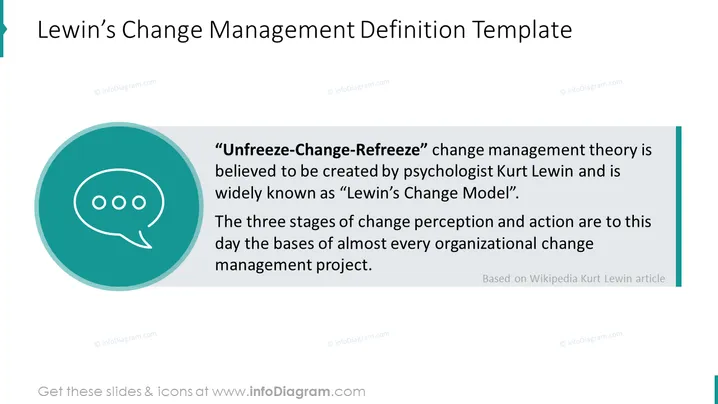
Rhis PowerPoint slide is titled Lewin’s Change Management Definition Template. The slide discusses the “Unfreeze-Change-Refreeze” change management theory created by psychologist Kurt Lewin. This theory is widely known as “Lewin’s Change Model”. The three stages of change perception and action are the bases of almost every organizational change management project.
This theory is widely known as “Lewin’s Change Model”. The three stages of change perception and action are the basis of almost every organizational change management project.
You can use this slide in a variety of contexts, such as:
This slide can be used to introduce Lewin's Change Model, a classic change management framework that describes the three stages of change: unfreeze, change, and refreeze. The unfreeze stage involves preparing the organization for change, the change stage involves implementing the desired change, and the refreeze stage involves embedding the change into the organization's culture and systems.
This slide can be used to help audiences understand the different stages of change and how they can be managed effectively. It can also be used to generate discussion about change management and the challenges and opportunities that it presents.