
Your graphics add a nice touch to my presentations and I recently used them for one of my all-hands meetings. Your toolbox adds professionalism to my slides. Instead of using standard clipart.
Claude Jones, Director of Engineer, @Walmartlabs, USA

Your graphics add a nice touch to my presentations and I recently used them for one of my all-hands meetings. Your toolbox adds professionalism to my slides. Instead of using standard clipart.
Claude Jones, Director of Engineer, @Walmartlabs, USA
I needed a fresh look at some of my slides. I've tried to find a way to create a paintbrush effect, to underline, accentuate, add some color and the handwritten markers were just the things. Very easy to use, easy to size, change the color. It was an affordable, perfect solution and I'm happy to recommend it.
Anonymous, US
The crisp, clean look of the graphics, and the fact that it allowed me to easily edit and change the colors to match the template was my main reason for purchasing them.
Brandie Jenkins, E-learning Developer, USA
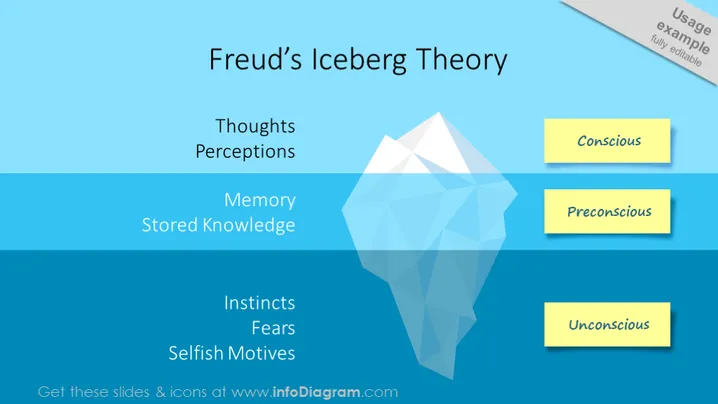
This slide presents Sigmund Freud's Iceberg Theory Model. He splits the iceberg into three parts- unconscious, preconscious, and conscious mind. This dogma has been accepted in psychology learning.
According to Freud, the hidden part of the iceberg represents our unconscious mind which consists of instincts, fears, and selfish motives. The middle part is the preconscious, which is connected to our memory and stored knowledge. The tip of the iceberg is actually our conscious mind such as thoughts and perceptions. This model apart from psychological aspects can be used in a management presentation as well. This model presentation is excellent for soft-skills training courses, and while talking about culture and literature.
This slide contains infographic elements such as an iceberg diagram vector, editable yellow sticky notes, abstract ocean blue background color, and a space for text comments.