Your graphics add a nice touch to my presentations and I recently used them for one of my all-hands meetings. Your toolbox adds professionalism to my slides. Instead of using standard clipart.
Claude Jones, Director of Engineer, @Walmartlabs, USA
Your graphics add a nice touch to my presentations and I recently used them for one of my all-hands meetings. Your toolbox adds professionalism to my slides. Instead of using standard clipart.
Claude Jones, Director of Engineer, @Walmartlabs, USA
I needed a fresh look at some of my slides. I've tried to find a way to create a paintbrush effect, to underline, accentuate, add some color and the handwritten markers were just the things. Very easy to use, easy to size, change the color. It was an affordable, perfect solution and I'm happy to recommend it.
Anonymous, US
The crisp, clean look of the graphics, and the fact that it allowed me to easily edit and change the colors to match the template was my main reason for purchasing them.
Brandie Jenkins, E-learning Developer, USA
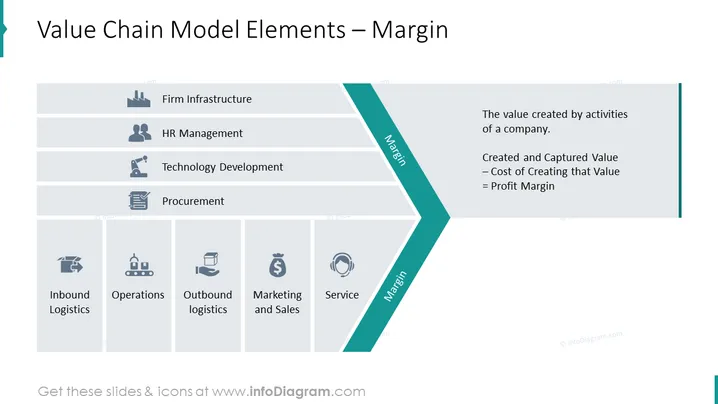
The PowerPoint slide depicts components of a company's value chain divided into primary and support activities, highlighted by a turquoise diagonal stripe labeled 'Margin'. Each activity is represented by an icon: 'Firm Infrastructure' with a factory icon, 'HR Management' by a person, 'Technology Development' by gears, 'Procurement' by a clipboard, 'Inbound Logistics' by a delivery truck, 'Operations' with a factory conveyor, 'Outbound Logistics' by a delivering van, 'Marketing and Sales' by a money symbol, and 'Service' by a headset. The 'Margin' stripe illustrates that the created and captured value minus the cost of creating value equals profit margin.
The slide has a balanced, professional appearance with a clear visual hierarchy. The division of content and use of icons make it easy to understand the relationship between components of the value chain and the idea of margin.
Explaining the value chain concept in a business strategy or operations management presentation.
Training sessions for employees to understand the various parts of the company's operations and their impact on profitability.
Part of the original request was inadvertently omitted. Here is the complete continuation for the Use Cases section:
Training sessions for employees to understand the various parts of the company's operations and their impact on profitability.
As part of a financial analysis to align costs with specific activities within the company and identify areas for improvement.
During a workshop or seminar on business models and efficiency to illustrate how different activities contribute to the overall margin.
In investor briefings to showcase how the organization manages its value chain and optimizes profit margins.