Tier-based B2B Segmentation Matrix
With Revenues (Value to Business) and Brand Contribution (Value to End-customer)
Slide Content
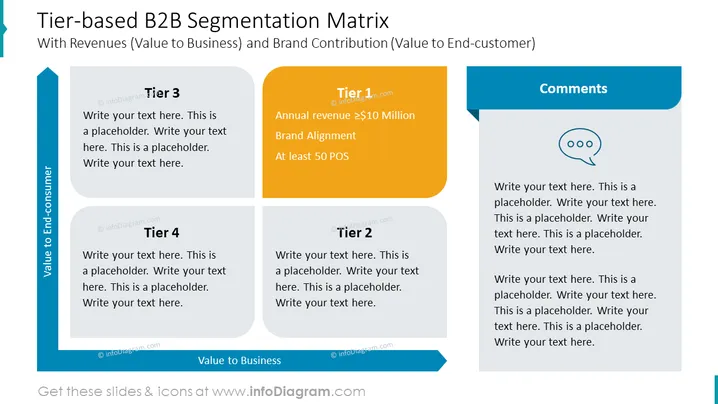
The slide titled "Tier-based B2B Segmentation Matrix" represents a framework for categorizing business-to-business relationships based on revenue and brand contribution. This matrix is useful for identifying and classifying different tiers of partners or customers. Tier 1 is highlighted with specific criteria such as a minimum annual revenue of $10 Million, brand alignment, and at least 50 points of sale (POS). The rest, Tier 2 to Tier 4, are placeholders for further details to be added, suggesting a potential for organizations to create their own criteria for each tier, which reflects the value those tiers bring to the business and their significance to the end customer.
Graphical Look
- The slide features a bold title at the top in large blue text, aligned to the left.
- A two-dimensional matrix is central, colored in shades of blue and orange, representing various tiers.
- Each tier is represented by a rounded rectangle with a distinct color - light blue for Tier 3 and 4, and orange for Tier 1 and 2.
- Tier 1 contains specific text criteria in a large orange rectangle, distinguishing it from the other tiers.
- The 'Value to End-customer' and 'Value to Business' axes are indicated by blue arrows on the left and bottom sides of the matrix.
- A separate, blue rectangular shape labeled 'Comments' is positioned on the right side of the matrix, with a speech bubble icon.
- Text placeholders in each section prompt users to add their own content.
The overall look of the slide is clean and professional, with a good balance of color and whitespace. The design is graphically appealing, conveying information in a structured, easily understandable layout.
Use Cases
- Used in strategic business meetings to discuss market segmentation and targeting.
- Helpful in sales presentations for illustrating the categorization of ## Tier-based B2B Segmentation Matrix
With Revenues (Value to Business) and Brand Contribution (Value to End-customer)
Slide Content
The slide illustrates a tier-based B2B Segmentation Matrix focused on categorizing business relationships with reference to revenue and brand contribution. Tier 1 is characterized by a substantial annual revenue benchmark ($10 million minimum), brand alignment, and presence across at least 50 points of sale, signifying the top segment. Tiers 2, 3, and 4 serve as placeholders to be detailed accordingly, suggesting a descending order of significance or partnership value, both in terms of business revenue and the value to the end-customer.
Graphical Look
- The title of the slide "Tier-based B2B Segmentation Matrix" is featured prominently at the top in dark blue font.
- A matrix is arranged in a quadrant format with rounded-edge rectangles, filled with placeholder texts, representing the tiers.
- Tier labels are in contrasting colors: orange for Tiers 1 and 2, and light blue for Tiers 3 and 4.
- A vertical blue arrow on the left side reads "Value to End-customer," while a horizontal blue arrow at the bottom reads "Value to Business."
- A comment box is on the right, with a blue background and a chat bubble icon.
- Each tier rectangle contains editable text, inviting users to input specific details relative to each segment.
The slide has a professional and cohesive color scheme, with orange and blue providing a clear contrast. The segmented layout promotes a straightforward interpretation of the hierarchy within the matrix. The overall design is clear, making complex information easily digestible.
Use Cases
- To visually communicate the classification of clients or customer segments in a business-to-business context during internal strategy discussions.
- As a tool for analyzing and presenting key customer segments to stakeholders or during investor presentations.
- Useful for sales strategy workshops to identify and prioritize lead qualification based on organizational revenue targets ## Tier-based B2B Segmentation Matrix
With Revenues (Value to Business) and Brand Contribution (Value to End-customer)
Slide Content
The "Tier-based B2B Segmentation Matrix" slide outlines a strategy to segment business-to-business relationships. Tier 1, with specifics like an annual revenue of at least $10 million, brand alignment, and a requirement of at least 50 points of sale (POS), represents the highest segment. Tier 2, Tier 3, and Tier 4 are marked as placeholders, allowing customization based on company-specific segmentation strategies. These criteria provide a structured approach to evaluate the importance of different B2B partners in terms of revenue potential and brand impact.
Graphical Look
- The slide's headline "Tier-based B2B Segmentation Matrix" is in dark blue, set against a light background.
- The layout consists of a tiered matrix with four rounded rectangles, each representing a tier and labeled "Tier 1" to "Tier 4."
- "Tier 1" and "Tier 2" rectangles are in orange, while "Tier 3" and "Tier 4" are in light blue.
- There are two instructive arrows labeled "Value to Business" and "Value to End-customer," one along the bottom and one running vertically on the left side of the slide.
- A separate rounded-corner rectangle on the right side indicates a space for "Comments," with a speech bubble icon.
- Inside each tier rectangle, there is placeholder text for adding specific details.
The slide employs a clean and structured design with a balanced use of color and space, facilitating ease of understanding and visual appeal. The color contrast helps to distinguish between the tiers, and the direction of arrows effectively emphasizes the axes of segmentation.
Use Cases
- To define and discuss customer segmentation during marketing strategy sessions.
- For evaluating and presenting potential business partnerships and opportunities in board meetings or to executives.
- To facilitate workshops and ## Tier-based B2B Segmentation Matrix
With Revenues (Value to Business) and Brand Contribution (Value to End-customer)
Slide Content
The slide presents a "Tier-based B2B Segmentation Matrix" that categorizes business-to-business segments based on revenue contribution and brand value to the customer. Tier 1 is defined by achieving an annual revenue of at least $10 million, aligning with the brand and maintaining at least 50 points of sale. Tiers 2, 3, and 4, depicted with placeholders, invite the addition of specific metrics or qualifications, forming a hierarchized view of customer or partner segments according to their business importance and customer value.
Graphical Look
- The title "Tier-based B2B Segmentation Matrix" is at the top of the slide in large, dark blue font.
- The matrix consists of four rounded rectangular shapes, with Tiers 1 and 2 in orange and Tiers 3 and 4 in light blue.
- Each rectangle houses placeholder text for the customization of tiers.
- Orange tier rectangles contain editable text fields, whereas the light blue rectangles are blank placeholders.
- A blue rectangular shape on the right, labeled "Comments," is intended for additional annotations and features a speech bubble icon.
- Two blue arrows labeled "Value to Business" (horizontal) and "Value to End-customer" (vertical) frame the matrix, indicating the axes of segmentation.
The design layout is clean, with a professional use of color and spacing that contributes to easy readability and a clear distinction between the segments. The matrix's visual hierarchy is reinforced by color-coded tiers and directional cues, making the segmentation intuitive.
Use Cases
- For strategic planning presentations to segment and prioritize business partnerships or customer relationships based on value.
- In sales and marketing meetings to align on target segments and tailor outreach efforts or resource allocation.
- In executive briefings or investor presentations to demonstrate a systematic approach to market segmentation and potential ## Tier-based B2B Segmentation Matrix
With Revenues (Value to Business) and Brand Contribution (Value to End-customer)
Slide Content
The slide introduces a conceptual "Tier-based B2B Segmentation Matrix," designed to classify business-to-business relationships through financial and branding lenses. Specific criteria for Tier 1 include an annual revenue threshold of $10 Million, a requisite degree of brand alignment, and a robust retail presence (50 or more points of sale). Tiers 2 through 4 are illustrated as placeholders, indicating where further segmentation details and criteria should be outlined based on revenue generation potential and the strategic importance to the end-customer.
Graphical Look
- The title is displayed at the top in dark blue font.
- Four rounded rectangles denote four tiers, with Tier 1 and Tier 2 in orange and Tier 3 and Tier 4 in light blue.
- There are two blue arrows with text indicating the two axes of the matrix: one pointing right for "Value to Business" and one pointing up for "Value to End-customer."
- On the right side, there's a "Comments" section, in a blue rectangle with a speech bubble icon.
- Each tier rectangle contains placeholder text, suggesting where customized content should be input.
The slide has a professional and straightforward design, with a contrasting color scheme and graphical elements that guide the viewer's attention. The layout facilitates an organized presentation of information, and text placeholders offer flexibility for user customization.
Use Cases
- To stratify customer segments in a business strategy or marketing presentation.
- For internal communication on key account management strategy or customer engagement prioritization.
- During sales training, to explain the levels of customer engagement and focus.
- In investor or board meetings, to display the business's approach toward market segmentation.