Reviews
Your graphics add a nice touch to my presentations and I recently used them for one of my all-hands meetings. Your toolbox adds professionalism to my slides. Instead of using standard clipart.
I needed a fresh look at some of my slides. I've tried to find a way to create a paintbrush effect, to underline, accentuate, add some color and the handwritten markers were just the things. Very easy to use, easy to size, change the color. It was an affordable, perfect solution and I'm happy to recommend it.
The crisp, clean look of the graphics, and the fact that it allowed me to easily edit and change the colors to match the template was my main reason for purchasing them.
Description
When to use Scrum?
Slide Content
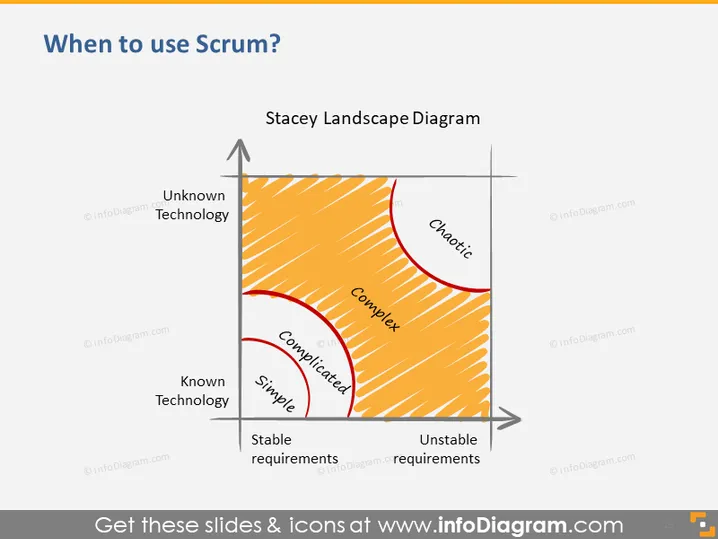
This PowerPoint slide is a representation of the Stacey Matrix, also referred to as the Stacey Landscape Diagram. The diagram categorizes projects or initiatives based on two axes — known to unknown technology (vertical) and stable to unstable requirements (horizontal). It is divided into four quadrants: Simple, Complicated, Complex, and Chaotic, each suggesting the level of uncertainty and the degree of coherence between requirements and technology.
- Simple: Clear relationship between cause and effect; routines and best practices are evident.
- Complicated: The relationship between cause and effect requires analysis or expertise; there are good practices.
- Complex: The relationship between cause and effect is only visible in retrospect; emergent practices are necessary.
- Chaotic: No clear relationship between cause and effect; novel practices must be applied.
Graphical Look
- The slide title is prominently displayed at the top in a large font.
- A subtitle "Stacey Landscape Diagram" is placed just below the main title.
- The main feature is the Stacey Landscape Diagram represented in a 2x2 matrix.
- The horizontal axis is labeled "Stable requirements" on the left and "Unstable requirements" on the right.
- The vertical axis is labeled "Known Technology" at the bottom and "Unknown Technology" at the top.
- Each quadrant of the matrix has a label: "Simple," "Complicated," "Complex," and "Chaotic."
- The quadrants are colored and shaded, creating a visual transition from one to another.
The slide has a clean and professional look, with the diagram taking center stage. The colors used for shading provide a gradient effect that visually differentiates between varying degrees of project complexity and technology familiarity.
Use Cases
- To train project managers and teams about appropriate project methodologies based on complexity.
- During strategic planning sessions to categorize and prioritize projects.
- In workshops or seminars explaining the agile framework and when to apply Sc rum methodologies.
- As part of a proposal to stakeholders to justify the selection of Scrum for a project with complex or volatile requirements.
How to Edit
How to edit text & colors

How to expand / shorten diagram

How to Replace Icons in infoDiagram PPT