Your graphics add a nice touch to my presentations and I recently used them for one of my all-hands meetings. Your toolbox adds professionalism to my slides. Instead of using standard clipart.
Claude Jones, Director of Engineer, @Walmartlabs, USA
Your graphics add a nice touch to my presentations and I recently used them for one of my all-hands meetings. Your toolbox adds professionalism to my slides. Instead of using standard clipart.
Claude Jones, Director of Engineer, @Walmartlabs, USA
I needed a fresh look at some of my slides. I've tried to find a way to create a paintbrush effect, to underline, accentuate, add some color and the handwritten markers were just the things. Very easy to use, easy to size, change the color. It was an affordable, perfect solution and I'm happy to recommend it.
Anonymous, US
The crisp, clean look of the graphics, and the fact that it allowed me to easily edit and change the colors to match the template was my main reason for purchasing them.
Brandie Jenkins, E-learning Developer, USA
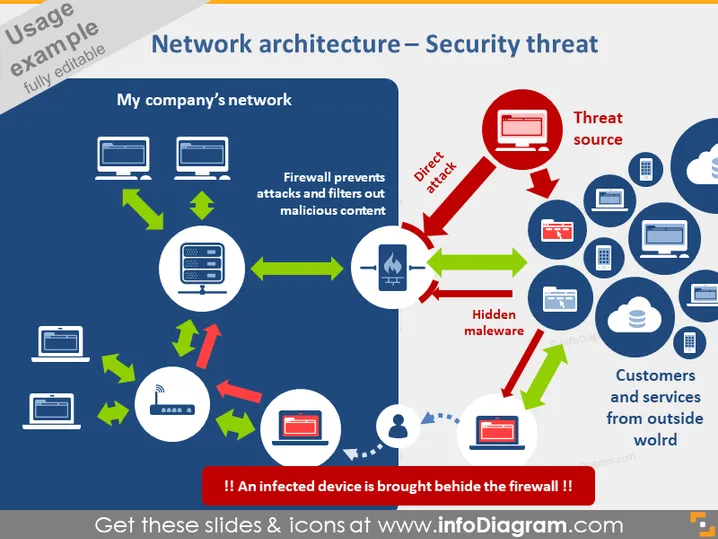
The slide presents a schematic visualization of a network security threat, specifically focusing on the challenges posed by both direct attacks and hidden malware. "My company’s network" represents the internal network, where computers are protected by a firewall that prevents attacks and filters out malicious content. "Direct attack" indicates an immediate threat targeting the network, while "Hidden malware" suggests the risk of compromised software within the network. "Threat source" consists of various technologies which could be vectors of cyber attacks. "Customers and services from outside world" imply interactions with external entities that could introduce risks. A cautionary note states "An infected device is brought behind the firewall," highlighting a common security breach scenario where a compromised device within the network's perimeter bypasses the firewall's protection.
The slide uses contrasting colors, arrows, and icons to visually represent the flow of information and potential security threats within a network. It provides a clear distinction between the protected internal network and the external threat sources.