
Your graphics add a nice touch to my presentations and I recently used them for one of my all-hands meetings. Your toolbox adds professionalism to my slides. Instead of using standard clipart.
Claude Jones, Director of Engineer, @Walmartlabs, USA

Your graphics add a nice touch to my presentations and I recently used them for one of my all-hands meetings. Your toolbox adds professionalism to my slides. Instead of using standard clipart.
Claude Jones, Director of Engineer, @Walmartlabs, USA
I needed a fresh look at some of my slides. I've tried to find a way to create a paintbrush effect, to underline, accentuate, add some color and the handwritten markers were just the things. Very easy to use, easy to size, change the color. It was an affordable, perfect solution and I'm happy to recommend it.
Anonymous, US
The crisp, clean look of the graphics, and the fact that it allowed me to easily edit and change the colors to match the template was my main reason for purchasing them.
Brandie Jenkins, E-learning Developer, USA
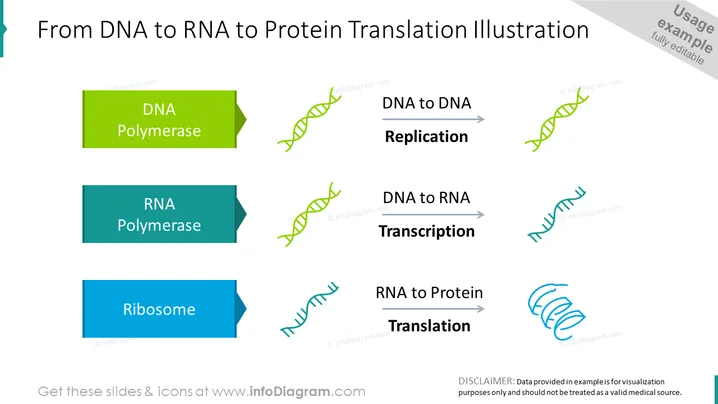
The slide provides a visual representation of the molecular biology process - From DNA to protein translation. It outlines three main steps: 'Replication,' where DNA polymerase creates a DNA copy, 'Transcription,' where RNA polymerase converts DNA to RNA, and 'Translation,' where a ribosome synthesizes protein from RNA. Each process is depicted with relevant enzyme names and graphic strands representing DNA and RNA, clarifying their inter-conversions and respective transformations.
The slide sports a clean and professional design, using color coding to distinguish between the different biological processes and their corresponding enzymes. The schematic representations of molecular structures complement the written content, enhancing understanding of the concepts.