Your graphics add a nice touch to my presentations and I recently used them for one of my all-hands meetings. Your toolbox adds professionalism to my slides. Instead of using standard clipart.
Claude Jones, Director of Engineer, @Walmartlabs, USA
Your graphics add a nice touch to my presentations and I recently used them for one of my all-hands meetings. Your toolbox adds professionalism to my slides. Instead of using standard clipart.
Claude Jones, Director of Engineer, @Walmartlabs, USA
I needed a fresh look at some of my slides. I've tried to find a way to create a paintbrush effect, to underline, accentuate, add some color and the handwritten markers were just the things. Very easy to use, easy to size, change the color. It was an affordable, perfect solution and I'm happy to recommend it.
Anonymous, US
The crisp, clean look of the graphics, and the fact that it allowed me to easily edit and change the colors to match the template was my main reason for purchasing them.
Brandie Jenkins, E-learning Developer, USA
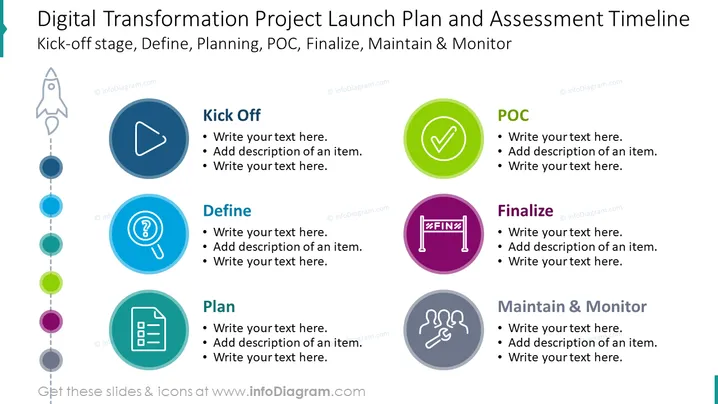
The PowerPoint slide describes a phased approach to digital transformation, starting with the Kick-off stage, followed by Define, Planning, Proof of Concept (POC), Finalize, and Maintain & Monitor. Each phase is intended for detailed elaboration, where the Kick-off involves initial project activation, Define focuses on establishing project parameters, Planning entails the detailed structuring of the project, POC is for testing the project's viability, Finalize is for refining and approving the project, and Maintain & Monitor is for ongoing oversight and improvement.
The slide has a clean, corporate design with a logical flow from start to finish, facilitated by the vertical timeline. The use of distinct colors and simple icons aids in distinguishing each phase of the project plan.
This slide would be used in business presentations to outline the steps of a digital transformation project. It could serve as an agenda for a kickoff meeting, a roadmap for project teams, or as part of a progress report to stakeholders. It would be particularly useful for project managers, IT teams, and consultants when discussing timelines, deliverables, and project stages with colleagues or clients.