Average DSO Analysis
Slide Content
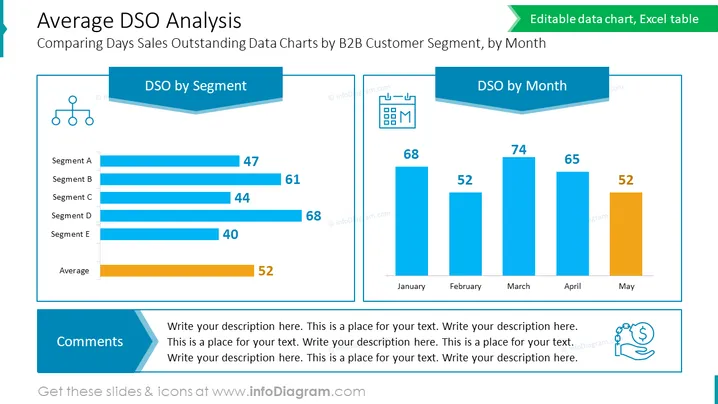
The slide presents data on "Days Sales Outstanding" (DSO) analyzed in two aspects: by business-to-business (B2B) customer segment and by month. On the left, individual segments are labeled from A to E, with their corresponding DSO values, accompanied by an average DSO value across all segments. On the right, the monthly DSO values from January to May are displayed, with changes indicating fluctuations over time. Both analyses are essential for assessing the efficiency of a company's credit and collections processes.
Graphical Look
- The slide title "Average DSO Analysis" is prominently displayed at the top in large font.
- The subtitle "Comparing Days Sales Outstanding Data Charts by B2B Customer Segment, by Month" provides context below the main title.
- Two main sections divide the slide, each with a ribbon-shaped header - "DSO by Segment" on the left and "DSO by Month" on the right.
- The left section features a horizontal bar chart with five blue bars each representing a B2B customer segment (A to E) and a sixth orange bar representing the average DSO across segments.
- Each bar is labeled with a number indicating the DSO value of that segment or average.
- The right section shows a vertical bar chart with five bars, each corresponding to a month from January to May. The bars are blue, except the one for May, which is orange.
- A text box labeled "Comments" is located at the bottom of the slide, featuring an icon suggestive of a speech bubble with a dollar sign, indicating a place for financial comments or remarks.
- The text within the "Comments" box is a placeholder for additional information.
The slide uses a clean and professional design, with a blue and orange color scheme and clear division of content. The use of horizontal and vertical bar charts makes it easy to compare DSO values visually.
Use Cases
- Present ## Average DSO Analysis
Slide Content
The slide titled "Average DSO Analysis" illustrates the "Days Sales Outstanding" (DSO) across different B2B customer segments and months. The left portion of the slide highlights DSO by Segment, with values for five distinct segments (A to E) and the average DSO shown as horizontal bars, conveying how each segment compares against one another and against the average. On the right, DSO by Month is depicted with vertical bars for each month from January to May, showcasing the temporal evolution or consistency in DSO. This side-by-side comparison of segments and months provides a clear overview of the accounts receivable performance in a given timeframe.
Graphical Look
- The slide has a clear, crisp title "Average DSO Analysis" in a large bold font.
- A subtitle detailing the content of the slide sits below the main title.
- The slide is split into two main sections with distinct headers: "DSO by Segment" with a blue background on the left and "DSO by Month" also with a blue background on the right, both with ribbon-like designs and small icons correlating to the datasets they represent.
- The left section features a horizontal bar chart where each bar symbolizes a different customer segment's DSO and is accompanied by numeric labels showing the actual DSO values.
- The right section showcases a vertical bar chart with monthly DSO data, again with numerical labels for precision.
- A comment box is positioned at the bottom, with a light blue background and a finance-related icon, intended for annotations or explanatory text.
The design of the slide is polished and business-like, with a blue and teal color palette that lends an air of professionalism. The charts are paired with icons, and the difference in bar chart orientation (horizontal vs. vertical) provides a visually engaging comparison of the data.
Use Cases
- To provide a financial overview during company board or investor meetings.
- For monthly or quarterly ## Average DSO Analysis
Slide Content
The slide is focused on the "Average DSO Analysis" where DSO stands for Days Sales Outstanding, an important metric in financial analysis indicating how long it takes a company to collect payments after a sale. The slide is divided into two parts: on the left, a horizontal bar chart "DSO by Segment" compares DSO values across different customer segments, indicating A has 47 days, B has 61 days, C has 44 days, D has 68 days, E has 40 days, with an overall average of 52 days. On the right, a vertical bar chart titled "DSO by Month" shows DSO values over a five-month period, specifying January (68 days), February (52 days), March (74 days), April (65 days), and May (52 days), with variations implying shifts in payment collection times.
Graphical Look
- The slide background is white, providing a clean and stark canvas for the content.
- A large blue banner with the title "Average DSO Analysis" spans the top of the slide.
- To the left, a blue horizontal bar chart with labels and values represents "DSO by Segment."
- To the right, a blue vertical bar chart showing "DSO by Month," with bars for January to May.
- There is a ribbon header above each chart, both containing a small pictogram (three connected circles for segments and a calendar for months) to illustrate the data type.
- The bar for the average DSO in both charts is highlighted in orange, contrasting with the blue bars.
- At the bottom, there's a comment box with an icon that combines a speech bubble and a money bag, signaling a place for financial annotations.
- Each chart and the comment box have subtle shadows, adding a sense of depth.
The overall design is professional with a neat layout, the use of blue and orange provides a clear visual differentiation of data points, and ## Average DSO Analysis
Slide Content
The "Average DSO Analysis" slide compares Days Sales Outstanding data across different B2B customer segments and by month, to characterize receivables efficiency. The "DSO by Segment" section reveals varying DSO values for segments A through E, plus an average DSO value, showcased as horizontal bars. "DSO by Month" displays vertical bars for each month from January to May, depicting DSO trends over time. This information is crucial for financial management, highlighting receivables performance and potential cash flow issues within specific customer segments or time frames.
Graphical Look
- The title "Average DSO Analysis" is prominent at the top in a large, bold font.
- A light-blue banner below the title offers additional context about the content related to B2B customer segments and monthly data.
- Two main content areas are visibly divided by a vertical line, each with a blue, ribbon-style header featuring the sections "DSO by Segment" and "DSO by Month".
- The left-hand chart is a horizontal bar graph representing DSO data by customer segment, with each bar accompanied by a numeric value.
- The right-hand chart is a vertical bar graph showing monthly DSO data, each bar also labeled with a numeric value.
- The charts are predominantly blue with the average DSO highlighted in orange.
- A blue "Comments" box at the bottom features a placeholder for text and an icon with a speech bubble and money symbol.
- Each section includes a small icon – a network for "DSO by Segment" and a calendar for "DSO by Month" – correlating with the data type.
The slide design is modern and corporate, using a color palette of blue, teal, and orange. The content is organized in a balanced and straightforward manner, allowing for easy comprehension and comparison of data across segments and time.
Use Cases
- Presenting financial performance metrics in executive summary reports.
- Discussing ## Average DSO Analysis
Slide Content
The slide titled "Average DSO Analysis" showcases a comparison of Days Sales Outstanding (DSO) data across B2B customer segments and by month. The left side provides a horizontal bar chart detailing DSO by Segment, with varying figures: Segment A with 47 days, Segment B with 61, Segment C with 44, Segment D with 68, Segment E with 40, and the average DSO at 52 days. The right side depicts DSO by Month in a vertical bar chart, reflecting values from January to May: 68, 52, 74, 65, and 52 days respectively. These data visualizations are instrumental for evaluating the efficiency of a company's accounts receivable and the speed of collecting payments from clients.
Graphical Look
- A bold, teal banner displays the title "Average DSO Analysis" at the top center of the slide.
- Below the title, a subtitle explains the comparison basis of DSO data by B2B customer segment and month.
- The left side of the slide exhibits a horizontal bar chart with five business segments labeled A through E, each displaying a numeric DSO value, and an additional bar for the overall average, highlighted in orange.
- The right side showcases a vertical bar chart with bars for each month from January to May, where each bar's length and the accompanying number display the DSO value for that month.
- The blue banners heading each chart section contain icons indicative of their content: a network diagram for "DSO by Segment" and a calendar for "DSO by Month."
- A comment section at the bottom has a placeholder text and is adorned with a financial icon – a money bag with a speech bubble.
The slide has a professional aesthetic with a clear delineation of information and a coherent color scheme that highlights key data points for quick comprehension. The overall layout facilitates an immediate understanding of the financial concepts presented.
Use ## Average DSO Analysis
Slide Content
The slide presents an "Average DSO Analysis," providing a comparative view of the Days Sales Outstanding (DSO) metric for B2B customer segments and by month. The left side charts DSO values across five customer segments (Segment A to E) with an additional bar depicting the overall average DSO. Notably, Segment D has the highest DSO at 68 days, whereas Segment E has the lowest at 40 days. On the right, a monthly breakdown from January to May shows fluctuations in DSO, with March peaking at 74 days. This information is crucial for assessing a company's efficiency in collecting receivables and managing cash flow.
Graphical Look
- The slide features a white background, giving it a clean and professional appearance.
- A teal header contains the title "Average DSO Analysis" in large, white font.
- Two sets of data are presented: one set displaying "DSO by Segment" with horizontal bars and another showing "DSO by Month" with vertical bars.
- Ribbon headers above each chart section, blue in color, label the data and include icons for a network and calendar.
- The horizontal bars for "DSO by Segment" and the vertical bars for "DSO by Month" use different shades of blue, with the average DSO highlighted in orange.
- At the bottom, a "Comments" section with an associated speech bubble and money bag icon offers space for annotations or observations.
- Each textual and graphical element is neatly contained with ample whitespace, ensuring easy readability and focus.
The slide exudes a sleek and uncomplicated design utilizing sharp graphics and harmonized colors to allow for effortless data visualization and interpretation. The subtle shadow effect adds depth to the charts and the comment box.
Use Cases
- Analyzing payment collection efficiency during finance department meetings.
- Demonstrating the company's financial health over a period to stakeholders in quarterly reviews.
- Identifying areas for ## Average DSO Analysis
Slide Content
The slide, titled "Average DSO Analysis," displays a comparative analysis of Days Sales Outstanding (DSO) by B2B customer segment and month. Horizontal bars indicate DSO for segments A through E, showing variation between segments, and an orange bar represents the overall average, drawing attention to the collective trend. On the adjacent side, each month from January to May is represented by a vertical bar, charting the evolution or consistency of DSO across the timeframe. The slide is valuable for businesses to evaluate the efficiency of their credit and collections process and understand the liquidity aspect with respect to time and customer segments.
Graphical Look
- Title "Average DSO Analysis" in a bold, blue font is presented on a teal header ribbon at the top of the slide.
- Subtitle "Comparing Days Sales Outstanding Data Charts by B2B Customer Segment, by Month" is directly below the main title, giving a brief explanation of the data context.
- Two distinct content sections with blue header ribbons and white icons indicate the data classification: network style for "DSO by Segment" and a calendar symbol for "DSO by Month."
- The left section's horizontal bar chart has blue bars corresponding to individual B2B customer segments, all labeled with numerical DSO values, and an orange bar for the average DSO.
- The right section includes a vertical bar chart with blue bars depicting DSO by month; each bar is marked with a number to indicate the specific DSO value, and the May bar is colored orange for emphasis.
- A blue text box labeled "Comments" with placeholder text and an icon of a speech bubble overlapping a money bag signifies a section for additional notes.
The slide is designed in a professional manner, employing a cohesive blue and orange color scheme which directs attention efficiently to key data points. The layout is spacious, clean, and well-organized, allowing for a clear visual representation of complex financial data ## Average DSO Analysis
Slide Content
The slide is entitled "Average DSO Analysis" and provides insight into the Days Sales Outstanding (DSO) across different segments and months, highlighting how quickly a company collects payments from its customers. On the left, DSO by Segment is illustrated with horizontal bars for each segment (A-E), alongside the average DSO represented by orange. To the right, DSO by Month features vertical bars from January to May, also highlighting the average in orange. This dual-perspective view allows for a comprehensive analysis of transactional efficiency by customer segment and time period, which is crucial for financial forecasting and decision-making.
Graphical Look
- The title is presented in a bold and large teal font set against a ribbon-style header.
- A concise subtitle describing the slide content sits under the main title.
- The slide is bifurcated into two distinct sections, "DSO by Segment" and "DSO by Month," each capped with a blue tab containing white icons indicative of their respective contents.
- "DSO by Segment" displays a blue horizontal bar chart with individual segments labeled and quantified.
- "DSO by Month" exhibits a blue vertical bar chart with bars for each month from January to May, including numerical values.
- The average DSO bar in both graphs is in orange, setting it apart from the other data points.
- A comment box at the bottom of the slide has a similar design theme and features a place for narrative insertion, accompanied by a money-related icon.
The slide possesses a clean and corporate aesthetic with a clear visual hierarchy, employing contrasting colors for emphasis and iconography for a quick understanding of the data provided.
Use Cases
- To review company performance in collecting receivables during a financial meeting.
- To present cash flow analysis to stakeholders in a quarterly business review.
- To identify areas for improvement in credit control during an internal audit presentation.