
Your graphics add a nice touch to my presentations and I recently used them for one of my all-hands meetings. Your toolbox adds professionalism to my slides. Instead of using standard clipart.
Claude Jones, Director of Engineer, @Walmartlabs, USA

Your graphics add a nice touch to my presentations and I recently used them for one of my all-hands meetings. Your toolbox adds professionalism to my slides. Instead of using standard clipart.
Claude Jones, Director of Engineer, @Walmartlabs, USA
I needed a fresh look at some of my slides. I've tried to find a way to create a paintbrush effect, to underline, accentuate, add some color and the handwritten markers were just the things. Very easy to use, easy to size, change the color. It was an affordable, perfect solution and I'm happy to recommend it.
Anonymous, US
The crisp, clean look of the graphics, and the fact that it allowed me to easily edit and change the colors to match the template was my main reason for purchasing them.
Brandie Jenkins, E-learning Developer, USA
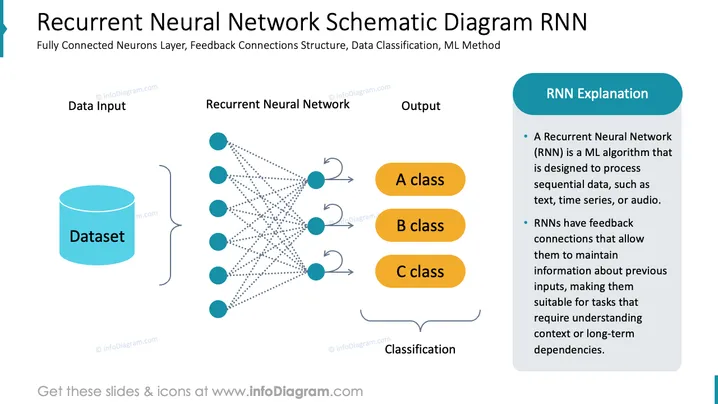
Die PowerPoint-Folie präsentiert die Architektur eines rekurrenten neuronalen Netzes (RNN), welches ein Algorithmus für maschinelles Lernen zur Verarbeitung sequentieller Daten wie Text, Zeitreihen oder Audio ist. Sie veranschaulicht den Datenfluss vom Eingang zur Klassifizierung und hebt die vollständig verbundenen Neuronenschichten sowie die Struktur der Rückkopplungsverbindungen hervor, die für RNNs unerlässlich sind. Das Diagramm gliedert das Konzept in drei Hauptkomponenten: Dateneingabe (Datensatz), das rekurrente neuronale Netz selbst und die Ausgabe, die in drei Kategorien klassifiziert ist (A-Klasse, B-Klasse, C-Klasse). Die Folie enthält auch eine kurze Erklärung zu RNNs, die ihre Fähigkeit betont, Informationen durch Rückkopplungsverbindungen zu erhalten, die es ermöglichen, Kontext oder langfristige Abhängigkeiten zu verarbeiten.