
Your graphics add a nice touch to my presentations and I recently used them for one of my all-hands meetings. Your toolbox adds professionalism to my slides. Instead of using standard clipart.
Claude Jones, Director of Engineer, @Walmartlabs, USA

Your graphics add a nice touch to my presentations and I recently used them for one of my all-hands meetings. Your toolbox adds professionalism to my slides. Instead of using standard clipart.
Claude Jones, Director of Engineer, @Walmartlabs, USA
I needed a fresh look at some of my slides. I've tried to find a way to create a paintbrush effect, to underline, accentuate, add some color and the handwritten markers were just the things. Very easy to use, easy to size, change the color. It was an affordable, perfect solution and I'm happy to recommend it.
Anonymous, US
The crisp, clean look of the graphics, and the fact that it allowed me to easily edit and change the colors to match the template was my main reason for purchasing them.
Brandie Jenkins, E-learning Developer, USA
Inhalt der Folie:
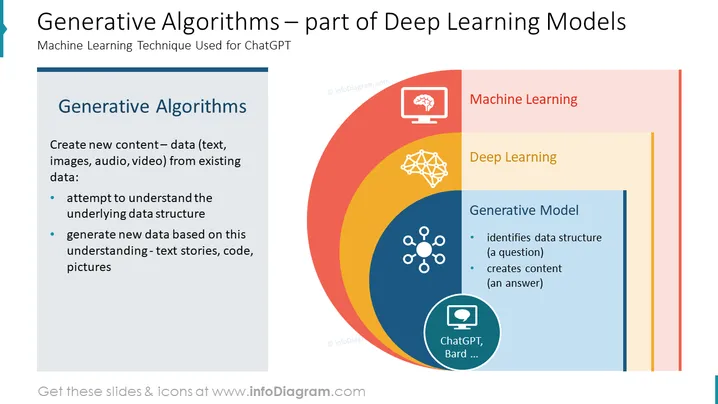
Diese PowerPoint-Folie trägt den Titel "Generative Algorithmen – Teil von Deep Learning Modellen" und diskutiert eine spezifische Technik des maschinellen Lernens, die für ChatGPT verwendet wird. Die Folie definiert generative Algorithmen als eine Methode zur Erstellung neuer Inhalte – Daten einschließlich Text, Bilder, Audio und Video – aus bestehenden Daten. Es wird erklärt, dass dies das Verständnis der zugrunde liegenden Datenstruktur erfordert und neue Daten basierend auf diesem Verständnis generiert werden, wie beispielsweise Textgeschichten, Code und Bilder. Die Folie stellt visuell die Beziehung zwischen maschinellem Lernen, tiefem Lernen und generativen Modellen in einem konzentrischen Kreisdagramm dar und weist darauf hin, dass generative Modelle Teil von Deep Learning-Frameworks sind, die wiederum unter die breitere Kategorie des maschinellen Lernens fallen. Generative Modelle werden als in der Lage beschrieben, Datenstrukturen zu identifizieren und Inhalte als Antwort auf eine Abfrage zu erstellen, wobei ChatGPT und Bard namentlich als Beispiele für generative Modelle genannt werden.
Graphische Darstellung:
Anwendungsfälle: