
Your graphics add a nice touch to my presentations and I recently used them for one of my all-hands meetings. Your toolbox adds professionalism to my slides. Instead of using standard clipart.
Claude Jones, Director of Engineer, @Walmartlabs, USA

Your graphics add a nice touch to my presentations and I recently used them for one of my all-hands meetings. Your toolbox adds professionalism to my slides. Instead of using standard clipart.
Claude Jones, Director of Engineer, @Walmartlabs, USA
I needed a fresh look at some of my slides. I've tried to find a way to create a paintbrush effect, to underline, accentuate, add some color and the handwritten markers were just the things. Very easy to use, easy to size, change the color. It was an affordable, perfect solution and I'm happy to recommend it.
Anonymous, US
The crisp, clean look of the graphics, and the fact that it allowed me to easily edit and change the colors to match the template was my main reason for purchasing them.
Brandie Jenkins, E-learning Developer, USA
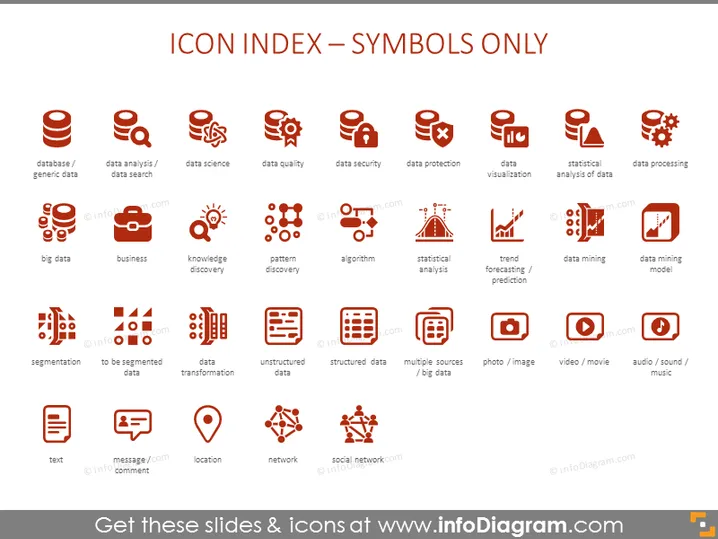
The PowerPoint slide is titled "ICON INDEX — SYMBOLS ONLY" and showcases various icons that represent different concepts related to data management and analysis. Each icon is labeled with a term that describes its intended use: "database / generic data" indicates a generic representation for databases, "data analysis / data search" suggests tools for examining and finding data, "data science" stands for the scientific methodologies applied to data, "data quality" highlights the importance of good data standards, "data security" emphasizes protecting data from unauthorized access, and "data protection" deals with safeguarding personal data legally. Other terms like "big data," "business," and "knowledge discovery" are self-explanatory, focusing on large data sets, commercial aspects, and uncovering new insights, respectively. "Pattern discovery," "algorithm," "statistical analysis," "trend forecasting / prediction," "data mining," and "data mining model" are analytical processes for finding patterns, devising computational instructions, performing statistical evaluations, predicting future tendencies, extracting useful information from large datasets, and constructing models for data mining. Technical processes such as "segmentation," "data transformation," "unstructured data," "structured data," and "multiple sources / big data" refer to dividing data into parts, converting data formats, dealing with data lacking predefined structure, organizing data into a defined format, and handling large volumes of data from various origins. Lastly, "text," "message/comment," "location," "network," "social network," and "photo / image," "video / movie," "audio / sound / music" icons relate to different types of content and ways in which information can be communicated or shared in digital formats.
The overall look of the slide is clean, professional, with a clear categorical distinction between icons. The consistent use of colors and styles provides a unified and visually appealing teaching or reference tool.