
Your graphics add a nice touch to my presentations and I recently used them for one of my all-hands meetings. Your toolbox adds professionalism to my slides. Instead of using standard clipart.
Claude Jones, Director of Engineer, @Walmartlabs, USA

Your graphics add a nice touch to my presentations and I recently used them for one of my all-hands meetings. Your toolbox adds professionalism to my slides. Instead of using standard clipart.
Claude Jones, Director of Engineer, @Walmartlabs, USA
I needed a fresh look at some of my slides. I've tried to find a way to create a paintbrush effect, to underline, accentuate, add some color and the handwritten markers were just the things. Very easy to use, easy to size, change the color. It was an affordable, perfect solution and I'm happy to recommend it.
Anonymous, US
The crisp, clean look of the graphics, and the fact that it allowed me to easily edit and change the colors to match the template was my main reason for purchasing them.
Brandie Jenkins, E-learning Developer, USA
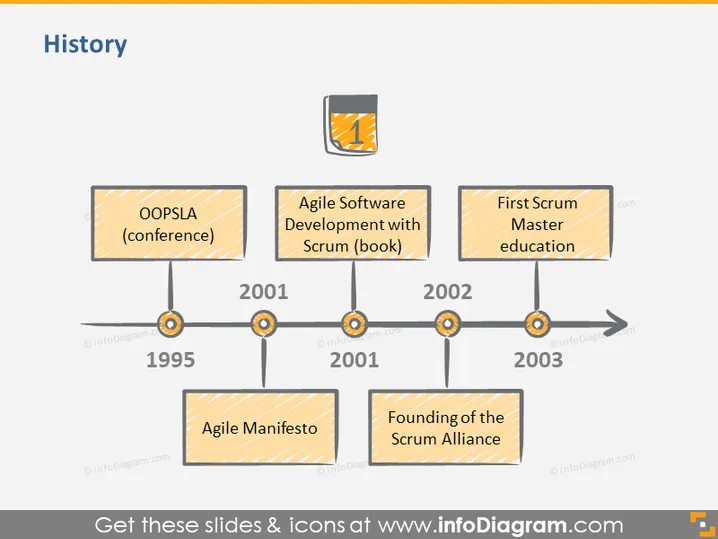
The slide provides a timeline of the history of Agile and Scrum developments from 1995 to 2003. In 1995, the OOPSLA conference took place, which is likely significant to the development of Agile methods. 2001 marks the creation of the Agile Manifesto, a defining moment in the history of software development. By 2001, the book "Agile Software Development with Scrum" was published, disseminating Scrum methodologies. In 2002, the first Scrum Master education began, implying the formalization of Scrum training. Finally, in 2003, the Scrum Alliance was founded, institutionalizing Scrum as a widespread methodology.
The overall look of the slide is clear and focused, using visual elements to effectively convey the historical milestones. The timeline is easy to follow and provides an at-a-glance understanding of the sequence of events.