Kirkpatrick Reversed Levels of Training Design Theory
Slide Content:
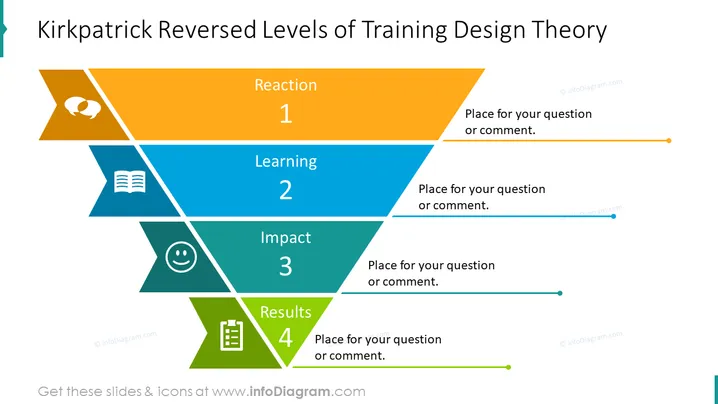
The Kirkpatrick Reversed Levels of Training Design Theory is a four-level model for evaluating the effectiveness of training programs. The levels are:
- Reaction: This level measures how participants felt about the training. It is assessed by asking participants to rate their satisfaction with the training, the instructor, and the materials.
- Learning: This level measures how much participants learned from the training. It is assessed by asking participants to demonstrate their knowledge and skills acquired during the training.
- Behavior: This level measures whether participants applied what they learned in the training to their jobs. It is assessed by observing participants' performance on the job or by asking them to report on their behavior change.
- Results: This level measures the impact of the training on the organization as a whole. It is assessed by collecting data on organizational performance, such as sales, productivity, or customer satisfaction.
Graphical Look:
The slide is divided into four quadrants, one for each level of the Kirkpatrick Reversed Levels of Training Design Theory. Each quadrant contains a text box describing the level and a graphic element representing it. You can illustrate the levels with symbols, for example:
- Reaction: A thumbs-up icon
- Learning: A lightbulb icon
- Behavior: A person running towards a finish line
- Results: A trophy icon
The slide uses a simple but effective visual design to communicate the Kirkpatrick Reversed Levels of Training Design Theory. The four quadrants are clearly defined and labeled, and the graphic elements are relevant and easy to understand. The slide is also well-balanced, with the text and graphics evenly distributed.
The colors used on the slide are bright and engaging, and they complement each other well. The background is white, which makes the text and graphics stand out. The text is black, which is easy to read. The graphic elements are in different colors, but they all use a similar saturation level, which creates a sense of unity.
The slide also uses icons to represent the four levels of the Kirkpatrick Reversed Levels of Training Design Theory. The icons are simple but effective, and they help to communicate the meaning of each level quickly and easily.
Overall, the slide is well-designed and visually appealing. It effectively communicates the Kirkpatrick Reversed Levels of Training Design Theory in a clear and concise way.
Where to use such a slide?
This slide can be used in a variety of settings, including:
- Training presentations: This slide can be used to introduce the Kirkpatrick Reversed Levels of Training Design Theory to participants and to explain how it will be used to evaluate the effectiveness of the training program.
- Training proposals: This slide can be used in training proposals to demonstrate to stakeholders how the training program will be evaluated and to ensure that the evaluation meets their needs.
- Learning and development (L&D) reports: This slide can be used in L&D reports to communicate the results of training programs and to demonstrate the impact of training on the organization.
- Academic presentations: This slide can be used in academic presentations to discuss the Kirkpatrick Reversed Levels of Training Design Theory and to illustrate its application in real-world settings.
In addition to these specific settings, this slide can also be used in any context where it is important to communicate the Kirkpatrick Reversed Levels of Training Design Theory and its importance in evaluating the effectiveness of training programs.