Your graphics add a nice touch to my presentations and I recently used them for one of my all-hands meetings. Your toolbox adds professionalism to my slides. Instead of using standard clipart.
Claude Jones, Director of Engineer, @Walmartlabs, USA
Your graphics add a nice touch to my presentations and I recently used them for one of my all-hands meetings. Your toolbox adds professionalism to my slides. Instead of using standard clipart.
Claude Jones, Director of Engineer, @Walmartlabs, USA
I needed a fresh look at some of my slides. I've tried to find a way to create a paintbrush effect, to underline, accentuate, add some color and the handwritten markers were just the things. Very easy to use, easy to size, change the color. It was an affordable, perfect solution and I'm happy to recommend it.
Anonymous, US
The crisp, clean look of the graphics, and the fact that it allowed me to easily edit and change the colors to match the template was my main reason for purchasing them.
Brandie Jenkins, E-learning Developer, USA
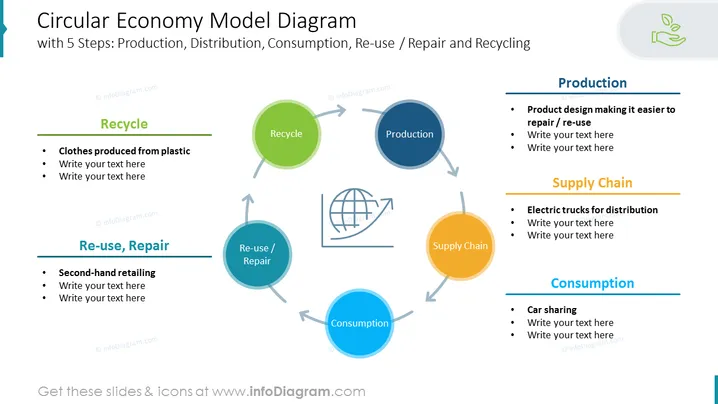
with 5 Steps: Production, Distribution, Consumption, Re-use / Repair and Recycling
The PowerPoint slide presents the "Circular Economy Model Diagram" which is mapped out in five steps: Production, Distribution, Consumption, Re-use / Repair, and Recycling. Each of these steps is represented by a circular colored icon with an adjacent text box for additional information. "Production" suggests product design that facilitates easier repair or re-use. "Distribution" is illustrated by electric trucks for distribution, showing the consideration for sustainability. "Consumption" introduces car sharing as a consumption model. "Re-use / Repair" includes second-hand retailing, promoting the idea of extending the lifecycle of goods. Finally, "Recycling" includes an example of clothes produced from plastic, highlighting the transformation of waste into useful products.
The slide has a clean, professional design utilizing simple graphics and distinct colors for each icon to emphasize the cyclical nature of the economic model. The use of arrows and strategic placement of the icons around the slide centralizes the concept of a circular economy.