
Your graphics add a nice touch to my presentations and I recently used them for one of my all-hands meetings. Your toolbox adds professionalism to my slides. Instead of using standard clipart.
Claude Jones, Director of Engineer, @Walmartlabs, USA

Your graphics add a nice touch to my presentations and I recently used them for one of my all-hands meetings. Your toolbox adds professionalism to my slides. Instead of using standard clipart.
Claude Jones, Director of Engineer, @Walmartlabs, USA
I needed a fresh look at some of my slides. I've tried to find a way to create a paintbrush effect, to underline, accentuate, add some color and the handwritten markers were just the things. Very easy to use, easy to size, change the color. It was an affordable, perfect solution and I'm happy to recommend it.
Anonymous, US
The crisp, clean look of the graphics, and the fact that it allowed me to easily edit and change the colors to match the template was my main reason for purchasing them.
Brandie Jenkins, E-learning Developer, USA
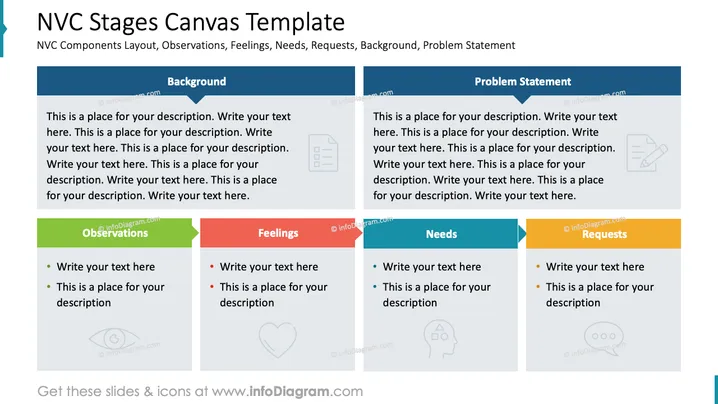
La diapositive présente le Canvas des étapes de la Communication NonViolente (CNV), en se concentrant sur cinq composants principaux : Contexte, Énoncé du Problème, Observations, Sentiments, Besoins et Demandes. Le Contexte fournit un cadre en expliquant la situation globale. L'Énoncé du Problème définit le problème central qui nécessite d'être traité. Les Observations détaillent des événements ou des comportements spécifiques observés. Les Sentiments expriment des réactions émotionnelles liées aux observations. Les Besoins identifient les exigences sous-jacentes qui motivent les sentiments. Les Demandes décrivent des actions spécifiques souhaitées pour répondre aux besoins.
La diapositive a un design structuré et épuré, utilisant un code couleur pour différencier les sections. Les icônes ajoutent une représentation visuelle pour soutenir le contenu textuel, renforçant la compréhension.