
Your graphics add a nice touch to my presentations and I recently used them for one of my all-hands meetings. Your toolbox adds professionalism to my slides. Instead of using standard clipart.
Claude Jones, Director of Engineer, @Walmartlabs, USA

Your graphics add a nice touch to my presentations and I recently used them for one of my all-hands meetings. Your toolbox adds professionalism to my slides. Instead of using standard clipart.
Claude Jones, Director of Engineer, @Walmartlabs, USA
I needed a fresh look at some of my slides. I've tried to find a way to create a paintbrush effect, to underline, accentuate, add some color and the handwritten markers were just the things. Very easy to use, easy to size, change the color. It was an affordable, perfect solution and I'm happy to recommend it.
Anonymous, US
The crisp, clean look of the graphics, and the fact that it allowed me to easily edit and change the colors to match the template was my main reason for purchasing them.
Brandie Jenkins, E-learning Developer, USA
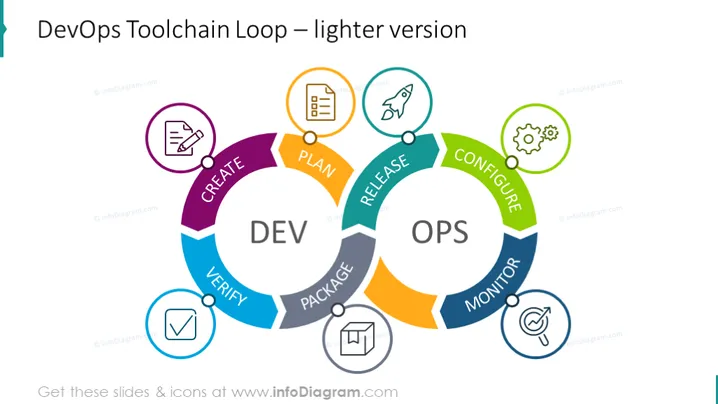
La diapositive PowerPoint présente un cycle illustré connu sous le nom de "Boucle d'outils DevOps", décrivant les étapes continues de développement et d'opérations. "CRÉER" implique de conceptualiser et de créer de nouvelles fonctionnalités logicielles. "PLANIFIER" est l'étape où les plans et stratégies logicielles sont développés. "CODE" représente la programmation réelle. "CONSTRUIRE" et "TESTER" sont des étapes suivantes dans le développement logiciel, se concentrant sur la construction d'une version fonctionnelle et la vérification de sa justesse. La phase "LANCER" garantit que le logiciel est prêt pour le déploiement, suivie de "DÉPLOYER". "FAIRE FONCTIONNER" implique l'exploitation quotidienne du logiciel, et "SURVEILLER" fait référence au suivi de la performance du logiciel pour informer de futures améliorations.