Your graphics add a nice touch to my presentations and I recently used them for one of my all-hands meetings. Your toolbox adds professionalism to my slides. Instead of using standard clipart.
Claude Jones, Director of Engineer, @Walmartlabs, USA
Your graphics add a nice touch to my presentations and I recently used them for one of my all-hands meetings. Your toolbox adds professionalism to my slides. Instead of using standard clipart.
Claude Jones, Director of Engineer, @Walmartlabs, USA
I needed a fresh look at some of my slides. I've tried to find a way to create a paintbrush effect, to underline, accentuate, add some color and the handwritten markers were just the things. Very easy to use, easy to size, change the color. It was an affordable, perfect solution and I'm happy to recommend it.
Anonymous, US
The crisp, clean look of the graphics, and the fact that it allowed me to easily edit and change the colors to match the template was my main reason for purchasing them.
Brandie Jenkins, E-learning Developer, USA
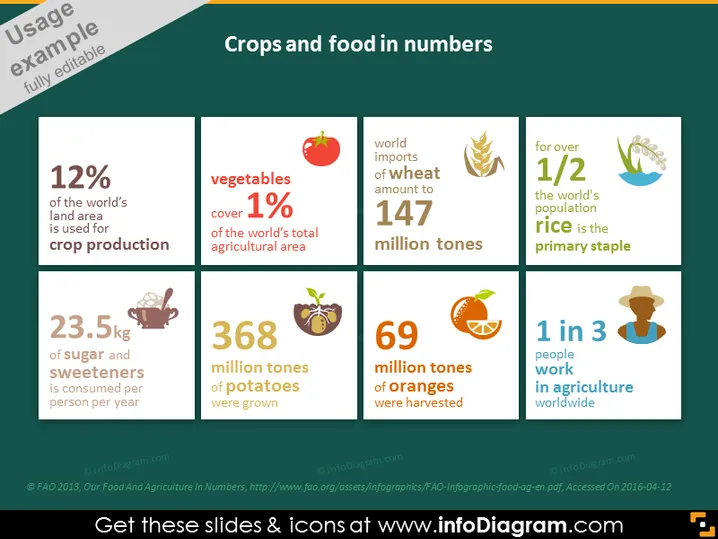
Die PowerPoint-Folie mit dem Titel "Pflanzen und Nahrungsmittel in Zahlen" präsentiert statistische Fakten über die globale Landwirtschaft und den Nahrungsmittelkonsum. Jede Statistik ist mit einem bunten Symbol verbunden, das das Thema darstellt. Die Folie besagt, dass 12% der Landfläche der Welt für den Anbau von Nutzpflanzen verwendet wird, was auf das Ausmaß der Landzuweisung für die Landwirtschaft hinweist. Gemüse nimmt 1% der gesamten landwirtschaftlichen Fläche der Welt ein, was auf einen kleinen Teil hinweist, der dem Gemüseanbau gewidmet ist. Die Folie erwähnt auch, dass weltweit 147 Millionen Tonnen Weizen importiert werden, was den globalen Handel mit diesem Grundnahrungsmittel zeigt. Sie hebt hervor, dass Reis ein grundlegendes Nahrungsmittel für mehr als die Hälfte der globalen Bevölkerungszahl ist, was seine Bedeutung unterstreicht. Erstaunliche 23,5 kg Zucker und Süßstoffe werden pro Person und Jahr verbraucht, was Bedenken hinsichtlich der Ernährungsgewohnheiten aufwirft. Darüber hinaus werden 368 Millionen Tonnen Kartoffeln und 69 Millionen Tonnen Orangen produziert, was das Ausmaß des Anbaus dieser Pflanzen zeigt. Schließlich wird festgestellt, dass 1 von 3 Menschen weltweit in der Landwirtschaft arbeitet, was den Einfluss des Sektors auf die Beschäftigung illustriert.